

The Keepers of the Quaich: Basically a ‘Whisky Knighthood’
Published November 5, 2025 by John Fegan
Contents
Scotland, being a land of mist, ancient stone and weather that has never once apologised, has created many traditions. Some of them are useful, like wearing wool because the alternative is hypothermia. Some are proudly symbolic. And some fall into that awkward middle category where everyone nods gravely and pretends they absolutely understand what’s going on, while quietly praying no one asks them to explain it.
Enter the Keepers of the Quaich, a society dedicated to honouring Scotch whisky, preserving heritage, and ensuring that tweed remains a viable global force. Think of it as a fellowship, but instead of a ring, the prized object is a cup, and instead of a volcano, there is a castle banquet hall with very good lighting. It is less a club than a whisky-powered honour guard, the sort of outfit where the dress code, the drinks menu, and the level of national pride all hit you at the same time, usually before the second dram.
There are around 2,800 members worldwide. This number is always described as “exclusive,” even though it’s the size of a small town in Scotland. One large enough for several whisky distilleries. The exclusivity, as far as I can tell, comes not from rarity but rather the highest known densities of tweed per square meter outside of an agricultural trade show, and the self-assurance of a group who does not need to check the pronunciation of the word Quaich. Its pronounced kwake with a Scottish ‘ch’ sound found in “loch.”
The Quaich Itself, Before Anyone Panics
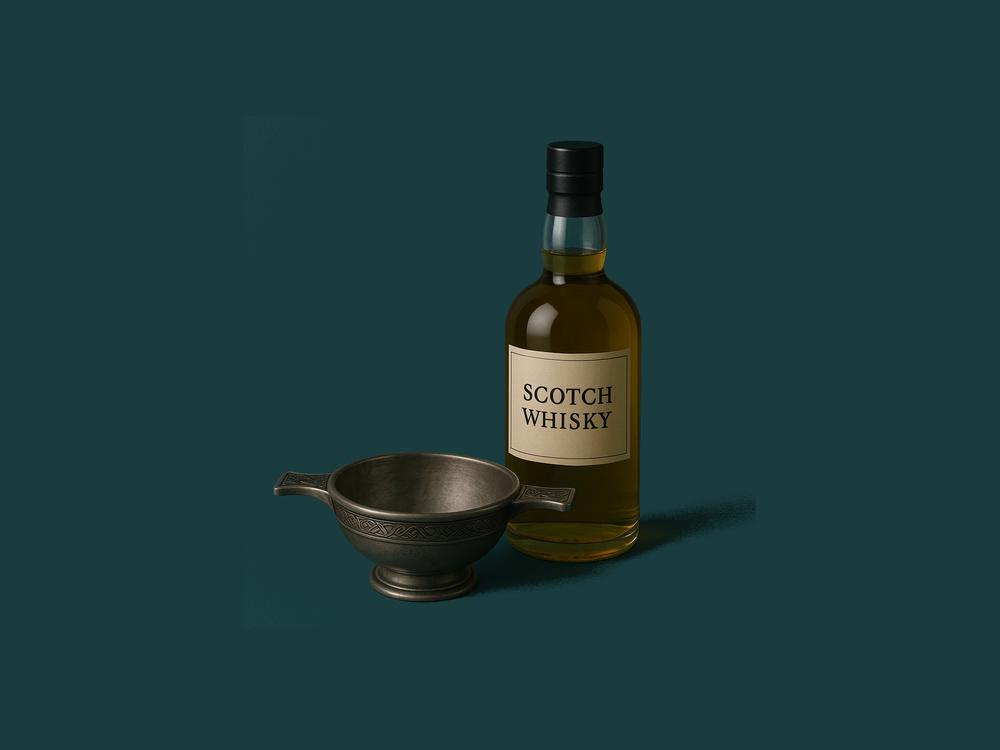
The quaich, for those who have not yet been cornered by a well-meaning Scotsman at a family wedding, is a small, shallow, two-handled drinking cup and traditionally Scottish. It is best described as what happens when a bowl and a trophy cup get together and raise a child to believe it is the embodiment of hospitality, trust, and slightly aggressive sharing.
The quaich is a deceptively innocent-looking wee cup, the kind of thing you’d assume is for drinking politely in a tartan-adjacent environment while someone plays the fiddle in the background. In reality, it is an ancient piece of social engineering designed to prevent homicide before dessert. The two handles weren’t decorative frills but policy. You held the quaich with both hands, which meant you couldn’t also hold a sword, dagger, or other objectionable item while drinking. In other words, it’s a cup that insists on good manners by physically disarming you. Early models even had glass bottoms so you could make sure nobody was planning to knife you under cover of toast. This is what historians call “trust,” or, more honestly, “reasonable suspicion with beverages.”
Quaichs started out as humble wooden cups, some made like tiny barrels, others carved from a single piece of wood but later graduated to silver, pewter, horn, and anything else someone could turn into a drinking vessel while being paid by the flourish. By the 17th century, silversmiths were engraving them like they were being judged in a beauty contest, and by the 19th century Sir Walter Scott was distributing them as if terrified Scotland might forget to drink socially.
Once upon a time, they held whisky, brandy, ale, or whatever passed for “hospitality liquid” at the gathering. Now they show up at weddings, graduations, and award ceremonies, usually presented empty, which feels like a missed opportunity.
Still, it remains Scotland’s official Cup of Friendship, the historical reminder that sharing a drink was once the simplest way to prove you weren’t intending to kill each other. It now mostly proves someone thought to buy good whisky. Progress comes in many shapes. This one has two handles.
Becoming a Keeper
The Keepers of the Quaich were founded in 1988, which means they are part ancient tradition, part late twentieth-century project, and entirely old enough to claim gravitas while still younger than compact discs, most action movies, and several types of cheese. Their founding mission is to celebrate Scotch whisky, which if we’re being honest is a bit like founding an official appreciation society for oxygen or a comitte devoted to the continued existence of gravity. People were already very enthusiastic about it and would continue to be with or without a governing committee. And if whisky were any more self-celebratory, it would throw itself a parade every time someone opened a bottle.
To be invited, one must have spent at least seven years promoting Scotch whisky. This may involve distilling it, marketing it, writing books about it or simply convincing enough people that they should drink it and be happy forever. Seven years was worked out as a point just long enough to realise that you do not fully understand whisky and never will, but you are too far in to stop now.
New members are nominated by existing Keepers. This is a formal affair involving hushed discussions, serious faces, and, let us be honest, a fair amount of whisky. Being invited is considered an honour, something like knighthood, but with fewer swordsand significantly better refreshments.
Once accepted, the Keeper is not assigned mystical duties. There are no codes to memorize, no secret handshakes and no requirement to defend the realm against invading vodka enthusiasts. Mostly, you just carry on doing what you already do: taking whisky with the kind of seriousness normally reserved for national budgets or football results.
The Rituals, Such as They Are
Twice a year, the Keepers gather at Blair Castle, which is large, historic and built at a time when architecture strongly believed in towers. The evening involves dining, drinking, and formalwear that feels like history and tailoring teamed up for a cosplay event.
There is tartan designed just for the society. The colors represent the ingredients of whisky: blue for water, gold for barley and brown for peat. There is no colour for the state of your head the following morning, which is probably for the best, as it would clash with everything and frighten small children.
A pipe band plays, which is the Scottish equivalent of telling the neighbours you are not even pretending this will be a quiet night. A giant ceremonial quaich is produced. New members approach, place a hand upon it and are inducted while attempting to look reverent rather than deeply aware of how many people are watching them. The whisky flows in ways that suggest gravity is not the only force at work.
A select few are elevated to the rank of Master of the Quaich,, a title that sounds like it should grant command of elemental forces or at least a small army of dram-carrying familiars. In reality it just means they have spent ten years around whisky without falling into a cask, setting fire to anything, and generally managed to avoid the kind of mishap that ends up retold in pubs for generations.
The Society motto is Uisgebeatha Gu Brath, which translates to “Water of Life Forever.” Which is optimistic, given the rate at which the members consume it.
Every Society has Secrets
The only true mysteries are the whiskies opened at the dinners. The Keepers are granted access to whiskies so rare they may as well be rumours. When someone describes them, it sounds less like a tasting note and more like a confession. These are bottles nobody else gets to drink, often because there is only one bottle. These whiskies are not sold in shops, not available at auction and technically may not exist in observable reality. Like quarks, time travel and people who actually read the terms and conditions.
The Keepers enjoy them, nod wisely and then pretend these whiskies do not exist. It is not a rule. It is simply that, when you drink something that rare, language stops being useful. The real secret of the Keepers of the Quaich is that they are having a much better time than you are, and they fully intend to keep it that way.
If you want to join them, you need seven years of whisky expertise, a sponsor from within the ranks, and a suit so expensive it requires its own insurance policy. Or you could just stay home, pour yourself a dram and avoid all the ceremony, politics and the uniquely motivational sound of bagpipes. You will not have the title of Keeper, but you will still have whisky, and when examined from the correct philosophical angle, that appears to be the true point of the exercise.