

Ankerstock: A Forgotten Scottish Christmas Bread
Published November 26, 2025 by John Fegan
Contents
What Was Ankerstock?
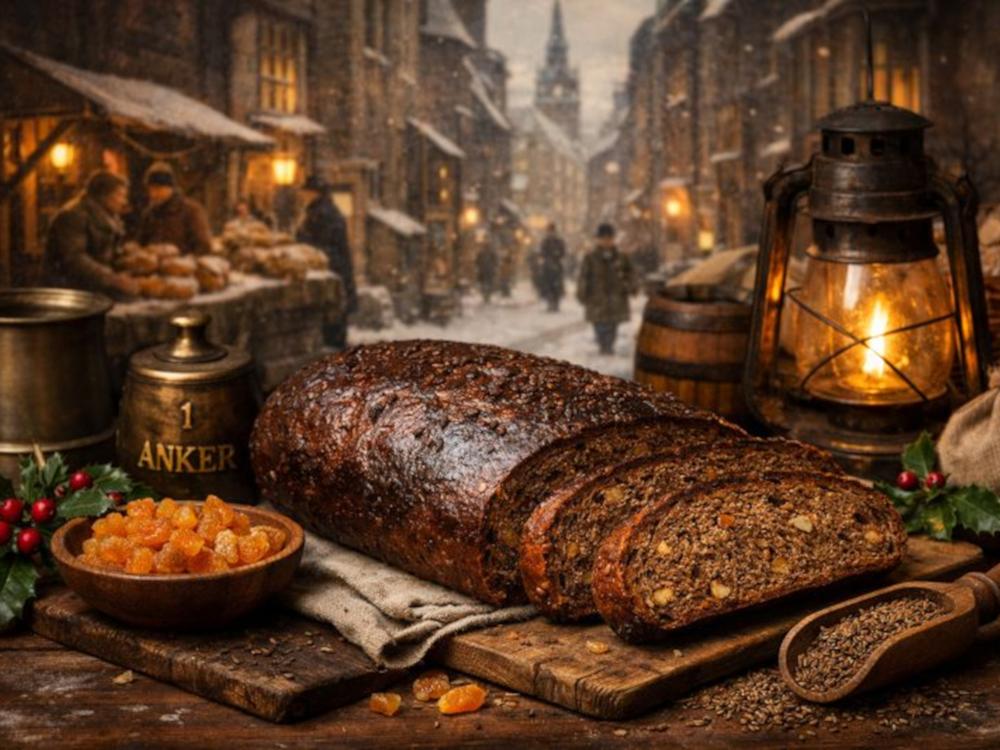
Ankerstock was a large, sweetened rye loaf seasoned with caraway seeds and candied orange. Ankerstock (often spelled anchor-stock or ankerstoke in older sources) was described by the Rev. Dr John Jamieson in his Etymological Dictionary of the Scottish Language (1808) as:
“A large loaf, of a long form. The name is extended to a wheaten loaf, but properly belongs to one made of rye.”
Rye bread was rare in Scotland, making Ankerstock both novel and festive. In Edinburgh it appeared seasonally on tables at the head of the Old Fishmarket Close, sold in sizes ranging from a halfpenny loaf to large household provisions.
A famous description from Blackwood’s Magazine (1821) reassures readers that citizens were not reduced to eating the wooden stocks of ship anchors, despite the bread’s formidable name.
Anker: Measure, Not Metal
Anker (Unit)
An anker was originally a Dutch unit of capacity used for wine or brandy, equal to approximately 10 US gallons. It became standard in parts of Colonial America, particularly New York and New Jersey, due to Dutch settlement in New Amsterdam. Across Europe, the size varied between 9 and 11 US gallons (approximately 34–42 litres).
In Scotland, however, anker developed a broader meaning. According to the Dictionary of the Scots Language, it was used not only as a liquid measure but also as a dry measure, particularly in northern Scotland, Orkney, and Shetland, where it was applied to butter, salmon, potatoes, and grain.
Historical quotations include:
- “Ther’s four ankers butter packed redy…”
- “An anker o’ tatties”
- “Ankers of Salmond”
Robert Burns casually refers to an anker of Ferintosh whisky in correspondence, showing it was a familiar unit of everyday exchange.
Ankerstock: Bread by the Measure
Rather than referring to anchors, Ankerstock almost certainly means a stock or loaf made to an anker measure bread defined by weight, bulk, and durability.
This interpretation aligns perfectly with the Swedish Ankarstock a Swedish rye bread, first recorded in 1669 and later issued as a military ration. A single loaf could weigh around 1.7 kg, enough to sustain one man for two days. It was designed to keep, travel, and be sliced sparingly; qualities prized during winter and the Daft Days alike.
Ankerstock in Scottish Food Culture
Ankerstock appears repeatedly in 19th-century literature. In The Life of Mansie Wauch (1839) D. M. Moir lists it alongside lavish quantities of shortbread, brandy, and spices as part of celebratory fare. F. Marian McNeill notes in The Scots Kitchen that it was still sold by Edinburgh bakers as late as 1929. By the mid-20th century, however, it had disappeared entirely.
Ankerstock or Rye Bread (Historic Description)
A contemporary description of Ankerstock preparation describes it as follows:
Requires very little yeast; mix with the water from two to six ounces of treacle for each pound of flour; let it be strained through a very fine gauze or lawn sieve, as treacle is often adulterated with sand; add salt, caraway, or anise of Verdun; the rye being sweet, the additional sweet gives it a determination, and corrects a disease to which that grain is liable, and makes the bread pleasant, healthy, and nourishing. It is an excellent sea store.
The emphasis on treacle, spice, and keeping quality confirms its role as both festive bread and provision loaf.
A Reconstructed Recipe for Ankerstock
This version is adapted from the now-defunct redbookrecipes.com, matches an older known family recipe, and corresponds closely with the Ankerstock described by F. Marian McNeill in The Scots Kitchen. It combines Scottish flavourings with a Scandinavian-style ferment.
Ingredients
Day 1 – Poolish
- 50 g wholemeal rye flour
- 7 g fast action yeast *
- 150 ml cold water
*Fast-action yeast is used here for modern convenience. Historically, Ankerstock would have been leavened with a natural rye ferment or barm (Brewers’ yeast skimmed from fermenting ale on days 2-4), and required only a small amount of yeast and a long, slow rise. For a more traditional bread use ~15g of sourdough or bam if you’re in to homebrewing (1–3 tablespoons of fresh barm per loaf).
Day 2 – Dough
- 150 g strong white bread flour
- 300 g wholemeal rye flour
- 200 ml water
- 75 g black treacle
- 15 g butter
- 10 g salt
- 10 g caraway seeds
- 100 g candied orange peel, finely chopped
- 1 egg (for glazing)
Method
Day 1
Whisk together the rye flour, yeast, and water until smooth. Cover and refrigerate for 12–24 hours.
Day 2
Melt the butter gently. In a large bowl combine the water, treacle, butter, and salt. Stir in the poolish, then add both flours. Knead for 3–5 minutes until cohesive but sticky. Incorporate the caraway seeds and orange peel near the end.
Cover and leave to rise for 1–2 hours until doubled.
Shape into a long oblong loaf or place into a greased loaf tin (23 × 13 cm). Prove for about 1 hour until doubled again.
Brush with beaten egg, score if desired, and bake at 200 °C for 30 minutes. Cool completely before slicing.
I’ve also found reference to other version of Ankerstock made using ginger and currents are also a popular replacement for candied orange.
Bread for the In-Between Days
Ankerstock is bread for the Daft Days: substantial, sweetened, slightly spiced, meant to last, and meant to be shared. It belongs to that slack, generous stretch of the year when time softens, rules loosen, and another slice is always justified because it is, after all, still the holidays.
Ankerstock and the Daft Days
Ankerstock belonged to the period known in Scotland as the Daft Days the stretch between Christmas and New Year when ordinary order loosened, hospitality expanded, and eating and drinking were expected to exceed good sense.
The Daft Days are remembered rather than formally observed. Daft here does not mean mad in the modern sense, but retains its older Scots meaning: giddy, carefree, and joyously unrestrained. In this sense, daft-days is a direct equivalent of the French fêtes de fous feast days of licensed excess, inversion, and laughter.
Ankerstock, a large loaf designed to keep well and slice thinly over many days, was perfectly suited to this in-between time. It was bread for tea-drinkings, posset cups, visiting neighbours, and the slow unwinding of the year.