

Bowmore and Laphroaig Merge Operations as Whisky Downturn Forces Islay Cut
Published February 25, 2026 by John Fegan
Two Ancient Islay Distilleries Attempt Sensible Behaviour, to the Great Suspicion of the Universe
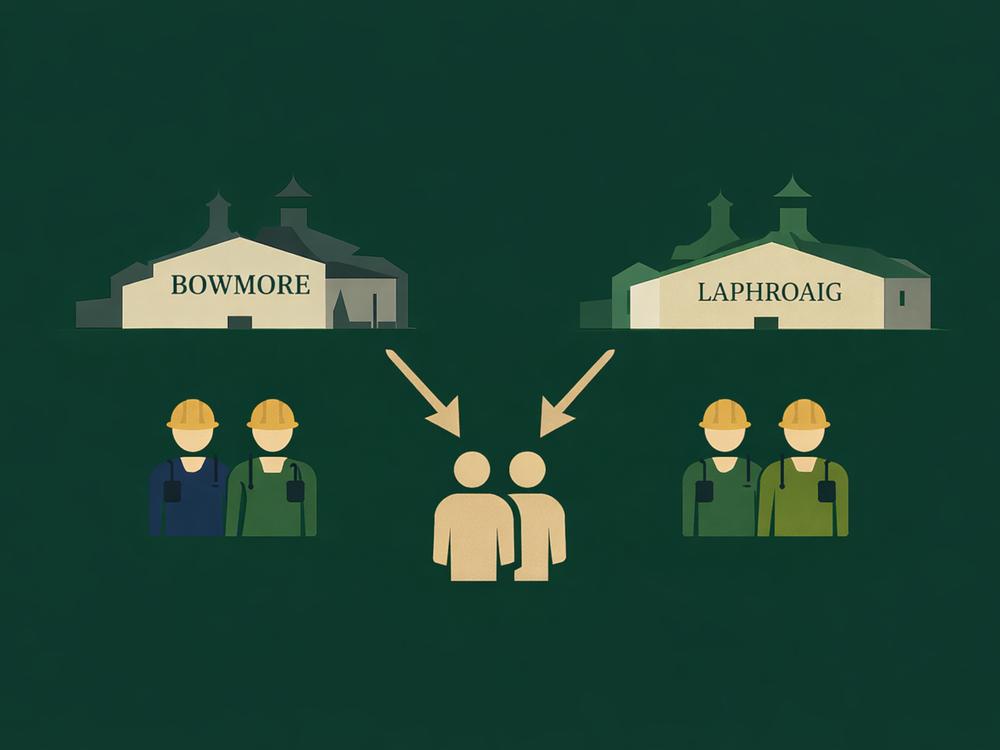
Bowmore dates back to 1779, when George III ruled and confidence in the future still felt like a reasonable default setting. Laphroaig followed in 1815, by which point that confidence had acquired a few dents. Both now sit under Suntory Global Spirits, whose latest bit of corporate logic holds that two operational teams can be combined into one, at least on paper and preferably without too much shouting.
Under the new arrangement, production teams will merge while management structures remain separate in order to preserve the brands’ distinct identities, rather like identical twins who insist they are entirely different people on the grounds that one prefers tweed and the other distrusts it on principle.
There are no compulsory redundancies planned, which is the corporate equivalent of saying nobody is being pushed off the boat. Instead, staff are being offered voluntary packages, a phrase that suggests choice in the same way that a menu suggests dinner is optional.
A spokesperson explained: “These are responsible, forward-looking adjustments to balance distillation with maturing inventory and protect the long-term health of the brands. “It is entirely voluntary, confidential, and supported by HR. It’s simply there as an option for colleagues who feel that the new single-team structure may not suit their individual needs.”
In less upholstered language, the exit is available and tastefully signposted while management stands nearby trying to make eye contact with all staff at once.
Distillation will continue at both sites, visitor centres will remain open, and Suntory has announced a “strong capital investment programme” over the next three years proof that while the present may be cloudy, the future still smells reassuringly of peat smoke and ambition.
Alistair Longwell, head of distilling and environment at Suntory Global Spirits, said: “Bowmore and Laphroaig are iconic Scotch whisky brands with exceptional heritage and craft, and they are long-term priorities for Suntory Global Spirits.
“As part of our commitment to producing whisky of the highest quality in a sustainable and efficient way, we are making operational adjustments on Islay to align production with long-term demand.
“Distillation continues at both distilleries, and we remain fully committed to Islay, our people, and the communities that have supported these whiskies for generations.”
The changes reflect updated production needs and follow seasonal operating models long familiar to the Scotch industry, much like the seasons themselves, though generally wetter and accompanied by considerably more paperwork.
The Great Whisky Contraction (Post-Pandemic Edition)
These adjustments arrive amid a downturn in the global whisky trade, which enjoyed a roaring boom during the Covid-19 lockdowns of 2020, when humanity collectively discovered that if one must stay indoors, one might as well do so with a decent dram.
Demand has since returned to something approximating normality, leaving warehouses full, prices less enthusiastic and export costs rising with quiet but impressive persistence.
Data from the BTG group indicates that 19% of Scotland’s distilleries are experiencing “significant or critical” financial difficulties. The number facing strain rose by 40.8% in the final quarter of 2025, increasing from 49 to 69.
In other words, one in five distilleries is currently staring at its accounts with the grim focus of someone checking a bank app the morning after a night out at a whisky bar.
Exports have also suffered. The United States — the largest export market for Scotch whisky by value — saw shipments fall by more than 4% in 2025 after former US president Donald Trump introduced a 10% tariff on UK imports. The slowdown has also been blamed on reduced consumption in key markets, reciprocal trade measures and a post-pandemic market correction.
The tremors have been felt elsewhere. Last month Diageo announced it would close the visitor centre at Clynelish distillery in Brora less than four years after a major tourism investment, demonstrating that even multimillion-pound refurbishments offer little defence against the invisible hand of the market, particularly when that hand has developed a fondness for arithmetic.
Despite the turbulence, Suntory insists Bowmore and Laphroaig remain “strategic priority brands” and reaffirmed its commitment to Islay and the local community.
Which is reassuring, because if there is one constant in a shifting universe filled with tariffs, downturns and economic alchemy, it is this: somewhere, in a warehouse older than several nations, a barrel of whisky is quietly becoming more valuable while doing absolutely nothing at all - a feat that economists, wizards and hedge-fund managers alike have been trying to replicate for centuries.