

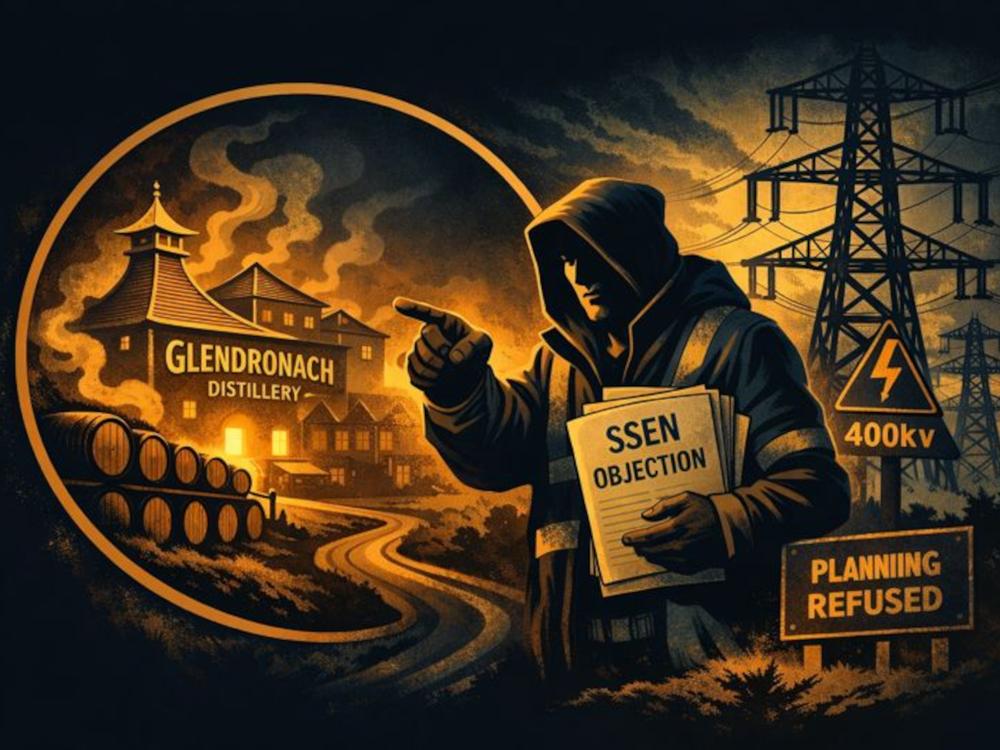
Glendronach distillery expansion blocked after SSEN objection
Published January 15, 2026 by John Fegan
In the rolling, peat-scented hills near Forgue, where the sheep were philosophical and the wind had been arguing with the trees since 1826, stood the Glendronach Distillery, quietly turning barley into history and occasionally into mild regret. Founded in 1826, it had survived wars, depressions, and several regrettable fashion trends in whisky bottles, but none so brazen as the plans concocted in Stirling. What it had not survived, at least not this week, was paperwork, a substance more corrosive than time and far less forgiving.
The Benriach Distillery Company, caretakers of this venerable institution, wished to build two new whisky warehouses, along with sprinkler tanks, a forklift-truck charging shed, and a road for things with wheels to arrive and depart without getting stuck in existential mud. Their application explained that the aim was to “build upon the continued success” of the Glendronach Distillery; which is how companies politely say everything is going splendidly and they intend to make it go even more splendidly, usually with an alarming amount of concrete and a heroic quantity of whisky.
They further informed Aberdeenshire Council that “the distillery plays an important role in supporting the local rural community and economy, the proposed development would reinforce this contribution because of the increased income generated by the additional storage space”. They also made sure to stress that “Category B listed structures on the main distillery site will continue to be well maintained because of the additional income generated.” It was all very sensible, very earnest, and precisely the sort of bureaucratic lullaby designed to send planning officers into a warm, compliant haze, which is exactly what it was meant to do.
Unfortunately, another mighty organisation had already set its sights on the same patch of countryside.
Scottish and Southern Electricity Networks (SSEN to its friends, enemies, and the weary souls who must type its name repeatedly) had plans for a truly heroic construction: the Beauly to Peterhead 400kV overhead line, a humming steel spine that would march across the landscape like a herd of industrial giraffes carrying bottled lightning.
SSEN objected, explaining that the warehouses would get in the way. In a letter that fairly bristled with suppressed irritation, they wrote: “Our proposed overhead transmission line and the proposed Class 6 distillery warehousing would not be harmonious on the basis of the competing land requirements associated with each respective development’s operational needs.” This was corporate language for your buildings are squatting exactly where our massive cable wants to go, and neither side is prepared to budge, so let’s call it a standoff.
They went on, with a sigh you could practically hear through the paper, “Given that we are now at a stage in our project design process that finalises the alignment, this prevents us from be able [sic] to change our alignment to avoid interaction with the proposed Class 6 distillery warehousing.” Which translated loosely means we have drawn the line in ink and the eraser is in another building — probably guarded by someone who has never smiled.
And finally, with the solemnity of a wizard explaining gravity to a falling apprentice: “As such, should the proposed Class 6 distillery warehouses be consented in accordance with the current plans, we could not construct our nationally significant new 400kV (400,000 volt) overhead electrical transmission line over these structures for safety, engineering and operational reasons.” This was the sort of sentence that made it very clear that someone, somewhere, had been paid to worry about these things and was enjoying it far too much.
The distillery, keen not to look unreasonable or end up lightly toasted, replied that SSEN “have specified that they are happy to discuss realignment of the overhead line to ensure a mutually agreeable solution is reached”. In other words: surely two grown-up organisations can work out where to stick their respective Very Large Things without anyone reaching for maps, lawyers, or ritual sacrifice, though given the history of such things, you wouldn’t bet on it.
But councils are not easily persuaded by optimism.
On January 5, Aberdeenshire Council dropped the metaphorical gavel, refusing the warehouses. Their head of planning explained that the buildings would not suit the “remote rural area”, and that the “proposal site clashes with the location of a new high voltage electricity transmission line”. This was council-speak for no, definitely not, and please stop asking.
And so, in the long-running scrap between whisky and electricity, the lightning won for now. The whisky will keep quietly doing what it does best, the pylons will creep ever closer, and somewhere in the hills of Forgue a barrel waits patiently, confident that one day it will be opened and this whole mess will finally taste worthwhile.