

Stirling Distillery Tests Aluminium Bottles for Scotch Whisky: Heriot-Watt Study Finds Chemical Interaction but No Sensory Difference
Published January 14, 2026 by John Fegan
In the grand old tradition of Scottish innovation, which usually involves standing in a cold shed arguing with a kettle until it gives up, Stirling Distillery has decided to ask a much bigger question than most people do before lunchtime. That question is whether whisky, a substance so steeped in glass that it practically expects to be admired through it, could be persuaded to live in aluminium instead, a concept that would give several barrels a mild existential crisis.
Happily this is not, as some purists fear, the opening move in a plan to sell single malt in ring pull cans next to the baked beans. It is a careful scientific venture involving Heriot-Watt University, the Institute of Chemical Sciences and a group of intensely focused people armed with magnets, spectrometers and clipboards, all working to understand how whisky behaves when its world changes. People who co-incidentally would look very out of place in a pub.
Kathryn Holm, co founder of Stirling Distillery, set the whole thing in motion. Her aim is to make sure that when the distillery releases its first mature whisky in 2027, it does so with as light a footprint on the planet as possible, and preferably not on anyone’s toes. And that in the meantime a few people outside the city know the distillery exists.
As she put it, “We want to make our distillery as sustainable as possible ahead of our first mature whisky being released in 2027. The whisky industry is looking at lots of ways to minimise its footprint. Glass has long been central to whisky’s image; it’s weighty, and evokes the craftsmanship of the spirit. But it is also heavy to transport and relies on high recycling rates to reduce its environmental impact. Aluminium is lighter and widely recycled, so I asked the experts to investigate whether it’s a viable alternative.”
This is the sort of statement that sounds perfectly reasonable until you imagine a 12 year old single malt being sealed inside something that previously held cola. The whisky industry has always liked its bottles the way it likes its stories, thick, heavy and able to survive being dropped, preferably on someone else’s foot.
Aluminium, however, has been quietly getting on with things for decades. It holds your soft drinks, your beans and the sort of takeaway meals that look like they were designed by an architect who has only encoutered food via vague description. It is lighter than glass and much more likely to be recycled. From a climate point of view, it is very appealing. From a whisky point of view, it is suspiciously modern, which in whisky circles is almost a swear word.
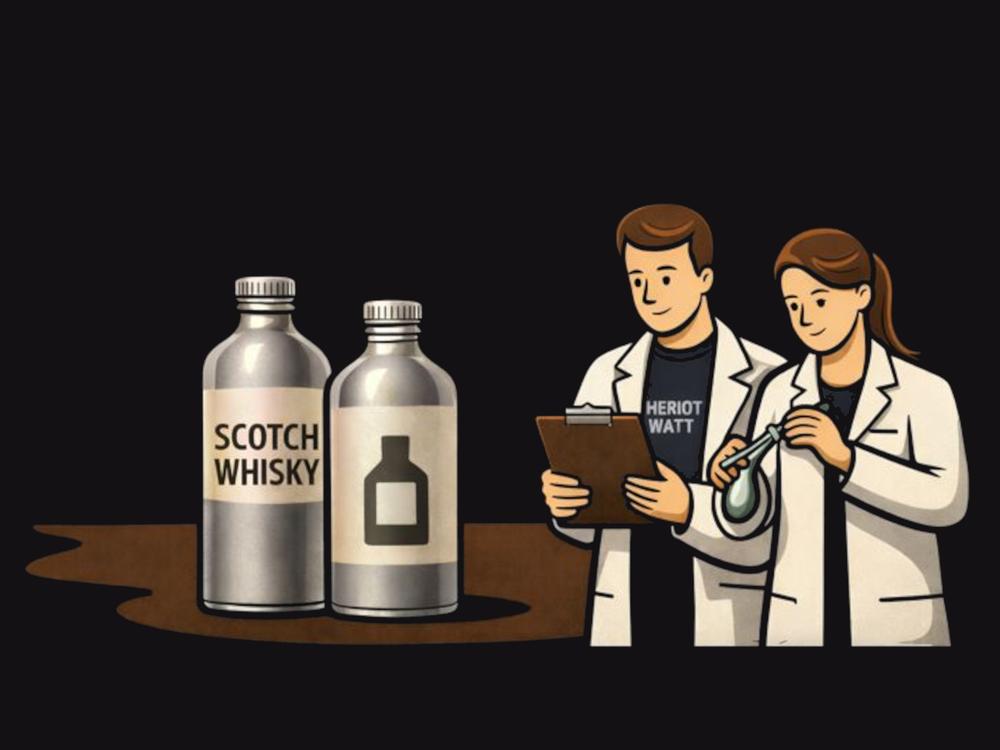
So the scientists at Heriot-Watt’s International Centre for Brewing and Distilling got to work. They filled aluminium bottles with whisky from Stirling Distillery and left them there for months, watching carefully to see what would happen. This involved a lot of very clever chemistry, including nuclear magnetic resonance spectroscopy and inductively coupled plasma mass spectrometry, which are the scientific equivalents of peering very hard at something until it confesses what it’s been up to, usually in Latin and sometimes with diagrams.
What they found was both encouraging and mildly alarming, which is the usual state of progress. Tiny amounts of aluminium did leach into the whisky. Dr Dave Ellis, who led the work with student Charlotte York, explained why. “We know that certain organic acids naturally present in matured whisky can react with aluminium, which can lead to aluminium entering the liquid. If we stir samples with aluminium metal, the levels were well above what would be considered acceptable for drinking water.” This was science-speak for your whisky is eating the bottle and presumably enjoying it.
In other words, whisky, which is famously good at dissolving things, was doing what it does best. Some of the flavour compounds that develop as whisky ages, such as gallic acid, were also reduced when they came into contact with aluminium. This effect was much smaller in new make spirit, which has not yet had time to become complicated.
Professor Annie Hill, who heads the whisky centre at Heriot-Watt, was not surprised. Food cans and drink cans, she pointed out, all have liners to stop their contents from reacting with the metal. “Any innovation has to respect the craft of whisky making while meeting the highest standards of safety. In this case the liner within the can wasn’t sufficient to prevent aluminium from passing into the spirit. The next stage of this research would be to find a liner that can withstand high alcohol levels for a prolonged period of time without degrading.” In other words, the whisky needed a better coat, ideally one that didn’t melt when things got spirited.
And then came the twist. Despite all the chemistry saying that things were happening, the human nose and tongue, which are famously unimpressed by graphs, could not tell the difference. A tasting panel led by student Andrew Marr tried whisky from aluminium bottles and whisky from glass and shrugged in a very professional way. Professor Hill summed it up. “Panellists couldn’t distinguish between whisky stored in aluminium from whisky stored in glass. So the changes detected in the laboratory didn’t translate into differences in aroma. That’s great news if we can find an effective liner.”
This leaves the whisky world in a curious position. On one hand, aluminium is lighter, more recyclable and much kinder to the planet than glass. On the other, whisky is a delicate, stubborn liquid that has spent centuries perfecting its relationship with glass and is not keen to be introduced to new metals without a chaperone. It’s also got a fairly rabbit fan base who haven’t gotten over the introduction of screw caps, let alone glass corks.
Kathryn Holm is not trying to smash the glass cabinet overnight. “We are not suggesting glass disappears tomorrow. But offering customers a lower carbon option for a premium product is something worth exploring. As a small distillery, we can help start that conversation.”
Somewhere in a warehouse in Stirling, casks are quietly ageing, unaware that when they finally emerge into the world, they might find themselves dressed not in the traditional heavy crystal but in something lighter, shinier and much more likely to have held fizzy pop in a previous life. Whisky has always been good at adapting. It survived Prohibition, bad blenders and novelty liqueurs. With the right liner, it might even survive a tin bottle.